 LAWLESS.EXE
For a long time, Lawless was just a shooting prototype. Spawn into a flat map, test weapons, restart, repeat. Useful for building mechanics. Terrible for building a game. That's finally changing.
The biggest thing I've been working on lately isn't weapons or procedural generation — it's structure. The connective tissue. The feeling that you're actually inhabiting a world instead of loading into a test chamber with a revolver.
Now the game finally has the beginnings of a real gameplay loop.
Back to the saloon
Every run now begins in the saloon.
You start in a dusty western bar, gear up, spend what little money you have, and head out on a bounty run. That's the rhythm the whole game is being built around: return to town, prepare, ride out, survive, kill the boss, come back richer — or don't come back at all.
The old prototype dropped you directly into combat. Functional, but empty. The saloon changes the tone completely. It gives the game a place to breathe before things get ugly again.
The run starts with whiskey and bad decisions. Ideally not in that order.
Right now the structure is simple:
- Start in the saloon
- Buy supplies
- Begin a run
- Fight through randomized encounters
- Kill the boss at the end
- Return with money if you survive
That's the foundation. The important part is that the game finally feels like it has direction.
Dollars matter now
There's now a working currency system: dollars.
Enemies and completed runs reward money, which can be spent before the next bounty. At the moment the economy is still basic, but the groundwork is there for a much larger progression system.
Currently planned purchases include:
- Ammo reserves
- Consumables
- Temporary buffs
- Trinkets
- Starting loadout modifiers
Some of these systems are still placeholders or partially implemented, but the important thing is the loop exists now. Surviving actually matters because resources carry meaning between runs.
The game finally remembers what happened to you.
Save profiles and persistence
One of the biggest quality-of-life additions is profile saving.
You can now save progress properly instead of treating every boot like a completely fresh prototype session. Dollars, unlocks, settings, and run progression now persist between sessions.
That sounds obvious for a game. It took longer than expected because almost every underlying system had to stop behaving like temporary debug code and start behaving like production code.
Pre-alpha development is mostly glamorous like that: you spend three days making menus remember volume sliders.
Rebuilding the interface
The entire UI has been overhauled.
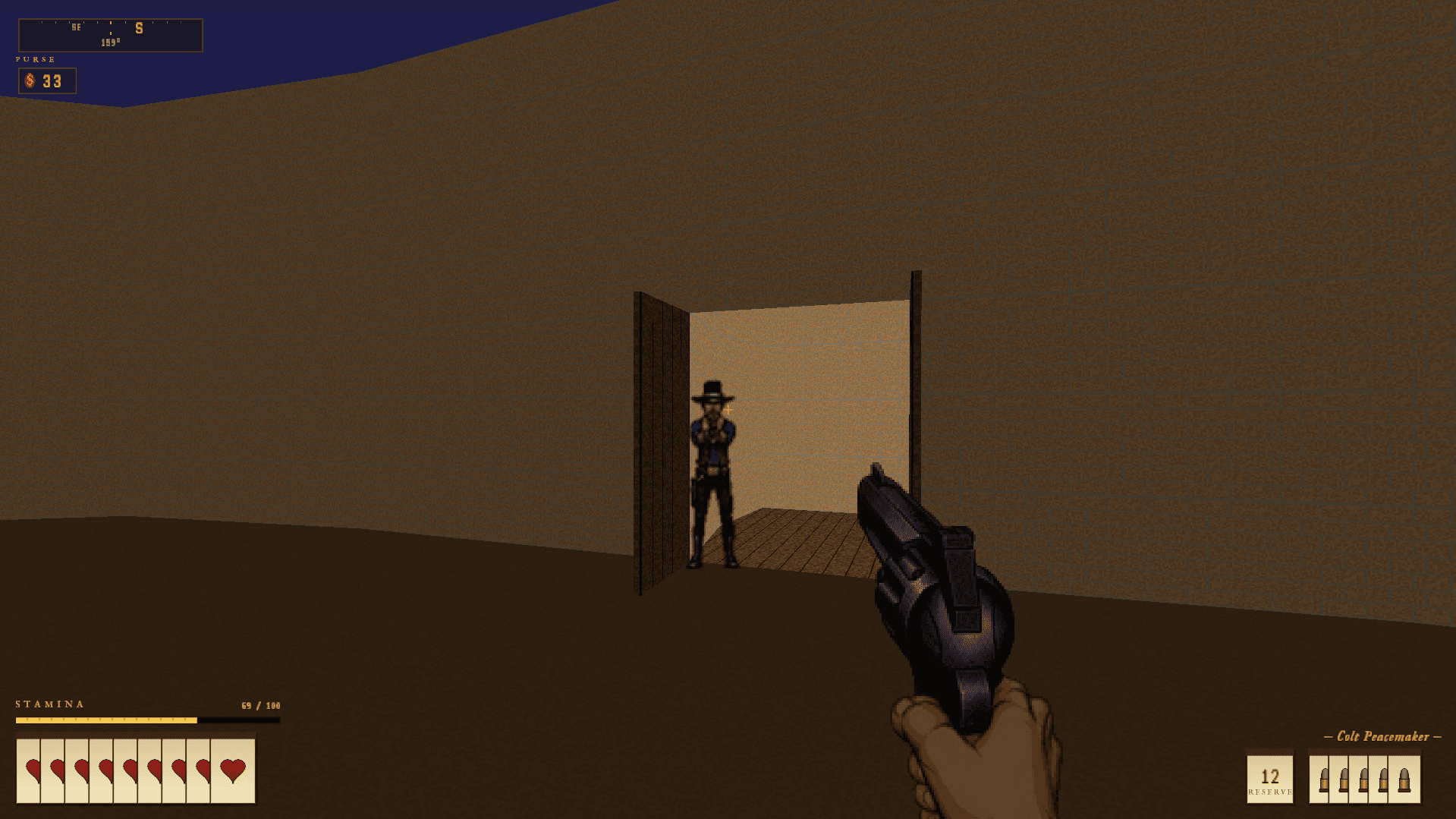
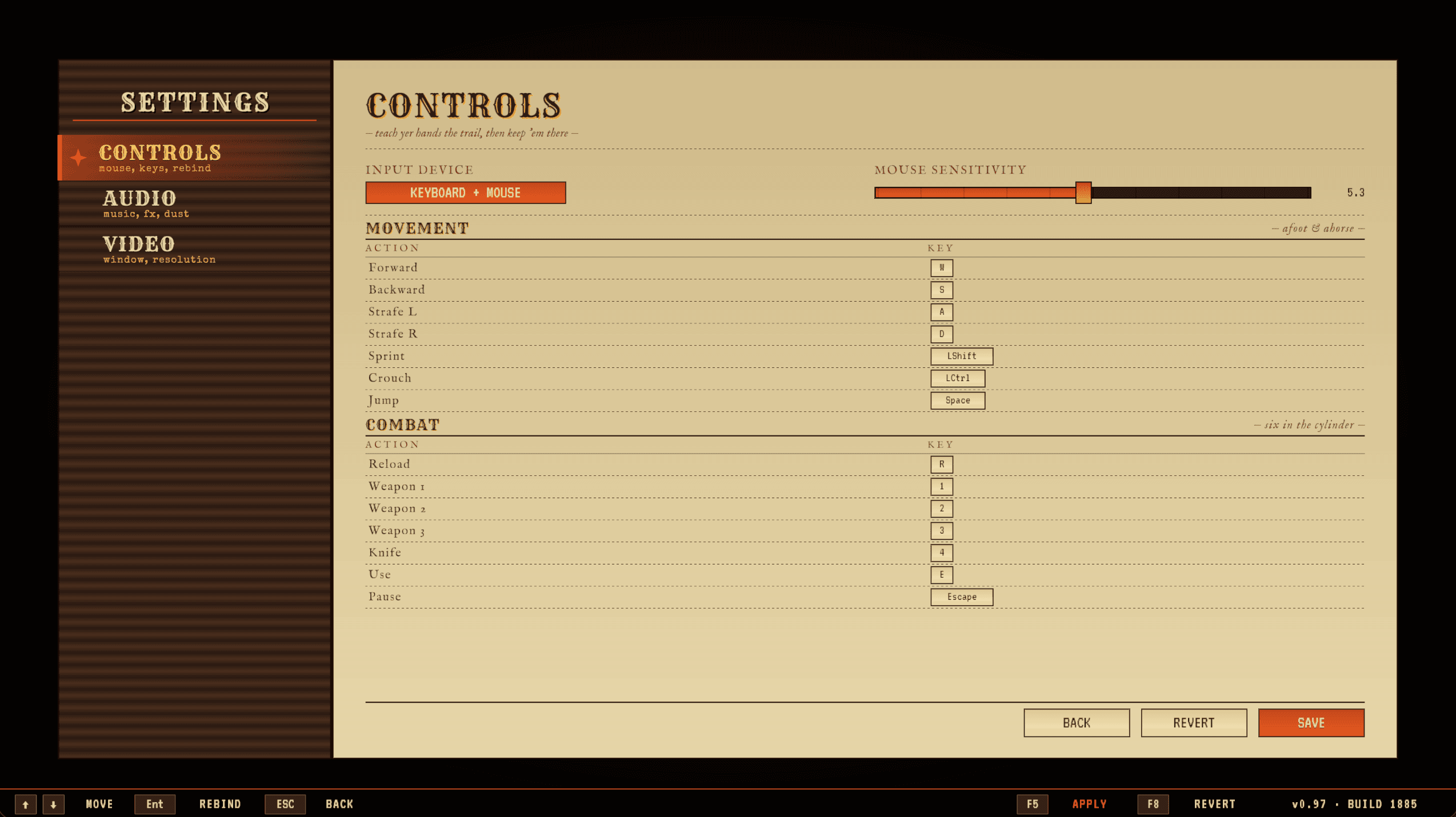
The original placeholder menus did their job, but they looked like engine tools pretending to be a videogame. The new interface is heavily inspired by the original Outlaws aesthetic — chunky western typography, dark wood tones, brass accents, old parchment textures — but cleaned up into something more modern and readable.
The goal isn't nostalgia for its own sake. I don't want a museum piece. I want the UI to feel like the version of Outlaws your memory invented instead of the one that actually shipped in 1997.
Everything is faster now too:
- Cleaner navigation
- Better HUD readability
- Proper settings menus
- Video settings
- Audio controls
- Rebindable controls
- General usability fixes everywhere
A lot of this work is invisible when it's done correctly. That's usually a good sign.
AI that finally reacts like human beings
The enemy AI has also gone through major changes. The old system was extremely simple: enemies could see you or they couldn't. That was basically the entire brain.
Now they're starting to behave more like nervous armed men instead of haunted mannequins.
Gunshots alert nearby enemies even without direct line-of-sight. Enemies investigate sounds. Groups can warn each other. Losing sight of the player no longer instantly resets combat — enemies push toward your last known position instead of forgetting you exist.
The biggest improvement is tension.
Before, clearing rooms felt mechanical. Now a bad shotgun blast can pull attention from somewhere deeper in the level. One fight creates another. You can feel situations deteriorating in real time.
The plan itself got absurdly large somewhere along the way. That's usually how you know you're building game AI.
Still early. Finally real.
Procedural generation is still in progress. A lot of systems are rough. Some mechanics exist mostly as promises held together by programmer stubbornness.
But this is the first time Lawless feels less like a renderer experiment and more like an actual game with momentum behind it.
You wake up in a saloon. You spend your last dollars. You load shells into a revolver that probably won't save you. Then you head back into the frontier anyway.
That's the shape of the thing now.
And honestly? It finally feels right.